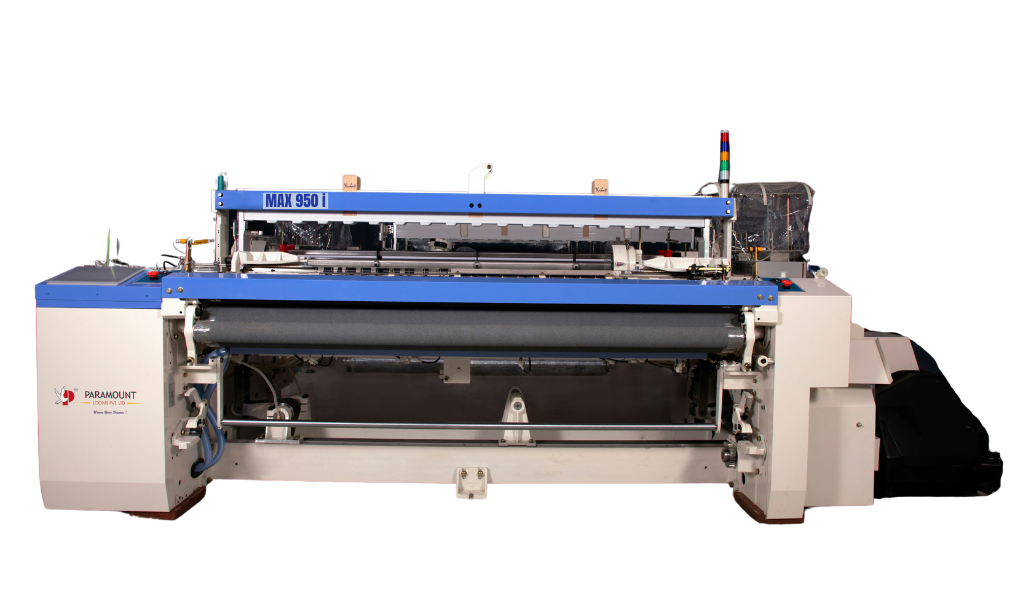
A practical comparison of air and water jet weaving based on yarn compatibility, utilities, fabric range and mill economics.
Bhiwandi
Paramount Looms Pvt. Ltd.
Air Jet Loom vs Water Jet Loom Manufacturer, Supplier & Trader in Bhiwandi
Air jet and water jet looms are both high-speed shuttleless weaving technologies, but they solve different production problems. For a mill in Bhiwandi, the correct choice depends first on yarn and fabric compatibility, then on compressed-air or water infrastructure, finishing process and long-term cost per meter.
Air Jet Loom vs Water Jet Loom: choose by application, not headline speed
Air jet looms insert weft using compressed air. They can handle a wider variety of yarn categories than water jet systems, but their operating economics depend heavily on compressor efficiency, pressure stability and low air leakage.
Water jet looms insert weft using a controlled stream of water and are especially effective with hydrophobic synthetic filaments such as polyester and nylon. Their mill requirements shift toward water quality, filtration, recycling, drainage and moisture handling.
Air jet: broader yarn versatility, compressed-air dependent.
Water jet: strongest on hydrophobic synthetic filaments, water-system dependent.
Both can achieve high speed when the fabric and utilities are suitable.
Neither should be selected solely on rated RPM or machine purchase price.
Business support
Manufacturer, Supplier and Trader support in Bhiwandi
Manufacturer
Manufacturing both technologies supports better comparison
Because Paramount Looms works with both Air Jet and Water Jet Loom technologies, the manufacturer discussion can begin with the customer's fabric instead of promoting one insertion method for every case. For a project in Bhiwandi, yarn behavior and end-use should be the first filters.
If the product mix needs broader yarn flexibility, air jet may be evaluated along with compressor capacity, CFM and pressure stability. If the core products use hydrophobic synthetic filaments such as polyester or nylon, water jet may offer attractive production economics when water quality, recycling and drying are properly managed.
The manufacturing comparison therefore includes machine structure and controls as well as the surrounding utility system. This gives the buyer a more realistic basis for calculating output, energy or water demand and long-term cost per meter.
Both technologies can be compared against the same yarn and fabric brief.
Machine choice is tied to utility infrastructure, not only rated RPM.
Configuration can be finalized after considering long-term production economics.
Supplier
Supply planning must include utilities
As a supplier, Paramount Looms can help a weaving unit in Bhiwandi compare the complete installation requirement for Air Jet and Water Jet Looms. Air jet supply planning includes compressor capacity, air treatment and piping, while water jet planning includes water source, filtration, recycling, drainage and drying considerations.
The machine specification is then compared on width, shedding, take-up, let-off, color requirements, automation and expected fabric program. This prevents a buyer from choosing a technology only because one quotation shows a higher theoretical speed.
Once the preferred system is identified, delivery and site preparation can be coordinated around the selected utility requirement so the mill is better prepared for commissioning.
Side-by-side utility planning for compressed air versus water systems.
Specification comparison using the same fabric and production targets.
Supply coordination after the most suitable technology is selected.
Trader
Trading support for technology-specific requirements
In some cases the most suitable air-jet or water-jet configuration may involve sourced technology or a partner machine. Paramount Looms can support such comparisons as a trader while maintaining a technical view of the customer's application.
The commercial evaluation can compare initial machine cost, utility investment, operating cost, yarn compatibility, fabric flexibility, maintenance, spares and support. This is more useful than treating Air Jet versus Water Jet as a simple price or speed contest.
For buyers in Bhiwandi, the trader role can therefore simplify sourcing while still highlighting the practical differences that influence profitability after the machine enters production.
Commercial comparison that includes utility and operating costs.
Sourced technology evaluated against yarn and fabric compatibility.
Decision support that goes beyond purchase price and headline speed.
Quick comparison
Air Jet vs Water Jet at a glance
Air Jet Loom
Uses compressed air for weft insertion. Suitable for a broader range of yarns and fabrics, but compressor power and CFM are major operating-cost factors.
Water Jet Loom
Uses water for weft insertion. Excellent for hydrophobic synthetic filament yarns, but requires water-quality, recycling and drying planning.
Air Jet Utility
Compressor pressure, air quality, leakage control and nozzle efficiency determine much of the real energy cost.
Water Jet Utility
Water source, filtration, recycling, drainage and moisture management are critical to efficient operation.
Applications & buying inputs
Which one should your mill choose?
Use the yarn and fabric as the first filter, then compare utility cost and product flexibility.
Choose air jet when the yarn/fabric range needs broader flexibility and efficient compressed air is available.
Choose water jet when the core products use polyester, nylon or similar hydrophobic synthetic filaments.
Compare long-term energy, water, maintenance and finishing cost rather than machine price alone.
If the mill changes fabric types frequently, rapier may also deserve comparison because of its versatility.
Before you request a quotation
Send the exact fabric specification and expected monthly product mix. Paramount Looms can compare air jet and water jet suitability together with utility requirements, rather than providing a generic “which is better” answer.
FAQ
Frequently asked questions about Air Jet Loom vs Water Jet Loom
Both can operate at high speed in suitable applications. Practical output depends on yarn, width, fabric construction, machine configuration and mill utilities.
It depends on local electricity, compressor efficiency, water cost, recycling, drying and the fabric program. A full cost-per-meter comparison is more useful than one utility number.
No. Water jet is best suited to hydrophobic synthetic filaments, while air jet can be considered for a broader range of yarns when pneumatic insertion is suitable.
Maintenance differs rather than being universally easier. Air jet requires attention to nozzles and compressed-air systems; water jet requires pump, nozzle and water-system care.